
loneliness in the MUMBAI SUBREDDITS
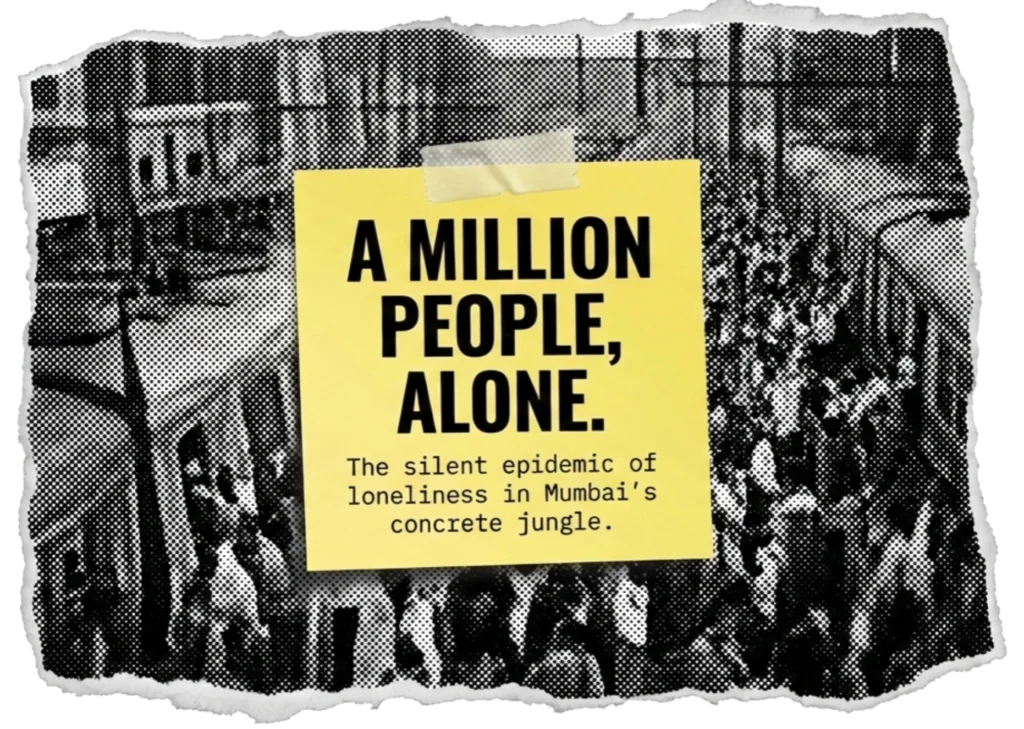
30,000 people populate every square kilometre of Mumbai. It is a city that never sleeps, never shuts up and never tires of feeding on the vitality of its prisoners. It’s metros wheeze into stations spilling human bodies like overstuffed drawers. Its traffic is sleep-deprived nervous system humming with anxiety. It’s dense, loud and sticky with ambition.
And yet, if you wander through the local Reddit communities tied to this city, especially micro-worlds like Powai and Navi Mumbai, you’ll find something almost obscene in its quietness. Post after post of people asking, sometimes gently, sometimes desperately, if anyone wants to talk. To meet. To exist together for a while.
The numbers are not subtle. A 24-month analysis of r/Mumbai, r/Powai, r/NaviMumbai, and r/Thane, covering over 25,000 interactions, found that 60 to 70 percent of analyzed posts explicitly cite isolation. In a city of 20 million people. Let that sit.
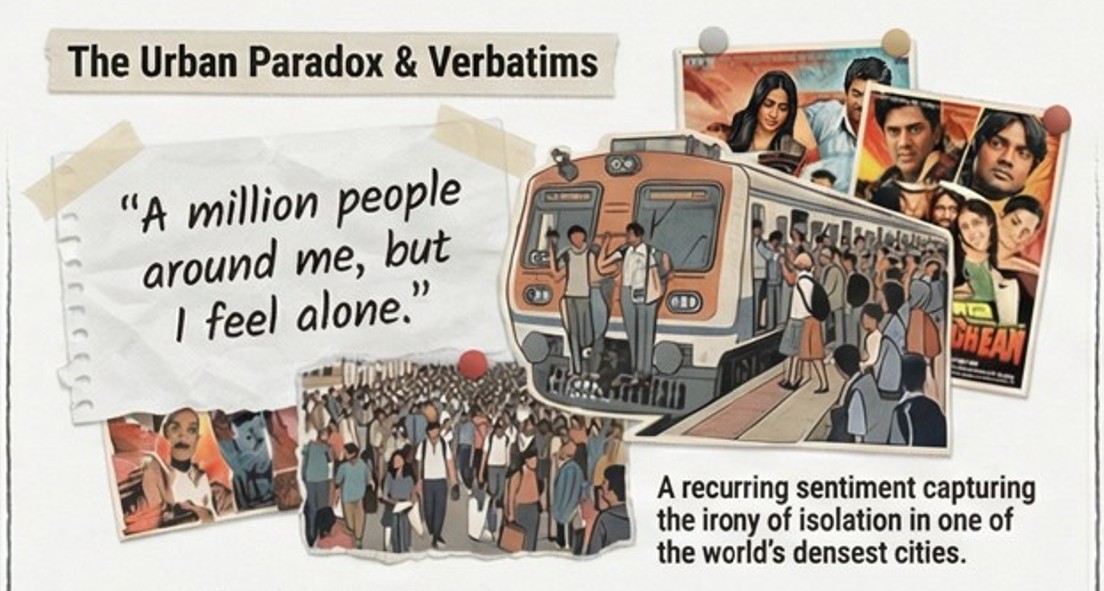
“A million people around me, but I’ve never felt so alone.”
That sentence doesn’t feel poetic. It feels clinical. A diagnosis delivered without drama. The paradox sits there, heavy and unblinking. Physical proximity, emotional exile. You can hear your neighbours sneeze through the walls, but you couldn’t name them if your life depended on it. Density does not equal connection. Mumbai is, apparently, the proof.
The Data of Disconnection
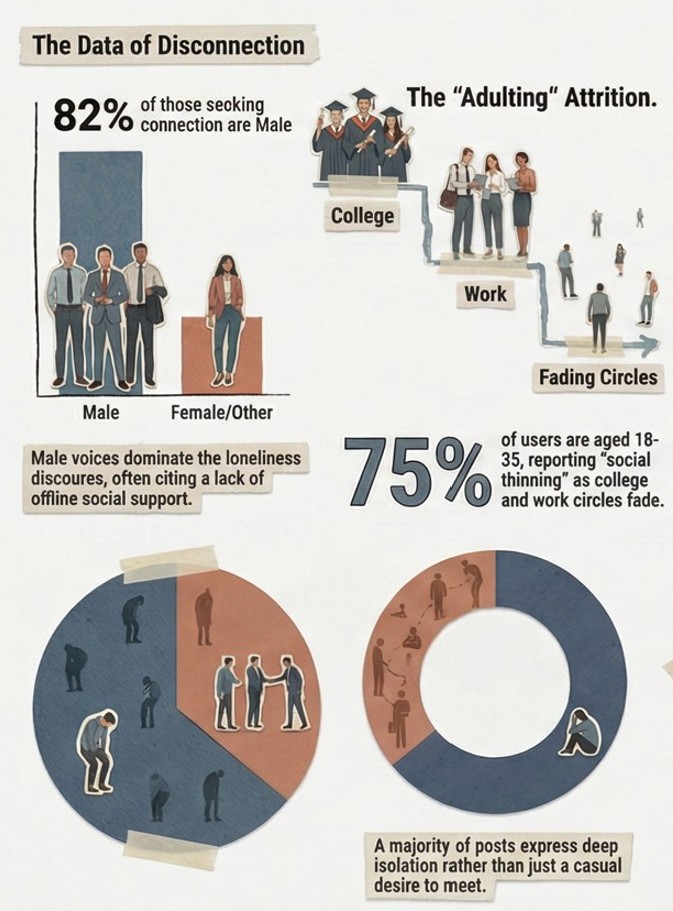
Here’s the first thing that hits you in the demographic breakdown: 82 percent of those actively seeking connection online are male. Eighty-two. The infographic doesn’t need to editorialize. The number does the work. Male voices dominate the loneliness discourse, often citing a complete lack of offline social support, and the Reddit anonymity seems to provide the only safe container for that admission. Men are, as the data suggests, statistically less likely to disclose loneliness face-to-face. So they type it out at midnight into a thread about Powai meetups and hope someone responds.
The age cohort is equally telling. Seventy-five percent of users reporting ‘social thinning’ are aged 18 to 35. That’s not a demographic footnote. That’s the entire productive workforce of urban India, quietly coming apart at the social seams even as they hustle for the next promotion. The Adulting Attrition, the research calls it. A slow erosion of the default friendship structures, college, roommates, routine, until you wake up one day surrounded by colleagues and realise you don’t actually know any of them.
And the dominant need? Not events. Not speed dating. Not networking mixers. A full 52 percent of sampled posts were seeking Friends and Belonging. Another 28 percent wanted Conversation and Support. Only 12 percent were explicitly looking for Dating or Intimacy, and even those, when you read the verbatims, aren’t really about romance. They’re about wanting to be chosen. To be seen. To be anchored in someone else’s attention.
The Urban Paradox and What People Are Actually Saying
“New in Mumbai… it’s suffocating.”
There’s one verbatim that I keep returning to. A user, newly relocated for work, writes:
‘I shifted for my new job. I honestly don’t know anyone here. The isolation has started choking me.’
Choking. That word is doing real labour. This isn’t someone whining about a slow weekend. It’s someone discovering that a new salary doesn’t come bundled with a support system. Mumbai will hand you opportunity with one hand and quietly erase your social scaffolding with the other.
The Newcomer’s Blues is a distinct archetype in the data. Relocation posts consistently combine genuine excitement with blunt social vacuum. The poster can function, job, commute, errands, but lacks the informal fabric that makes a city feel inhabitable rather than just navigable. Navi Mumbai posts specifically keep citing ‘the silence of the apartment’ as a motif. Not the silence of countryside or meditation. The silence of an apartment building full of strangers who collectively decided not to knock.
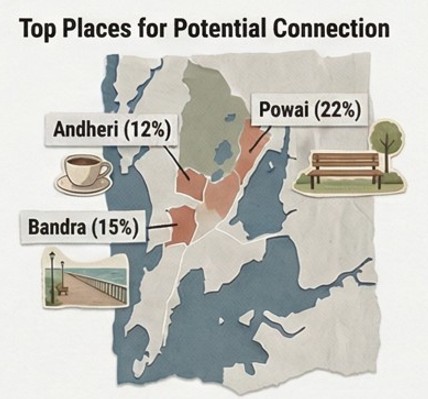
Powai, interestingly, emerges as the top neighbourhood for potential connection at 22 percent of such mentions, followed by Bandra at 15 percent and Andheri at 12 percent.
There’s something almost sociologically revealing about that geography. Powai is IT campus territory, full of relocators, young professionals, WFH-heavy tech workers who moved for a job and ended up marooned on an island of glass buildings with excellent Wi-Fi and zero community infrastructure. Of course it’s where the loneliness posts cluster.
The Emotional Spectrum: It Isn’t Boredom. It’s Heavy.
The raw emotional data from the Reddit analysis is striking not for its drama but for its uniformity. Sadness and Overwhelm dominate at 36 percent. Frustration and Longing come in at 24 percent. Despair and Hopelessness at 12 percent. The broader infographic report aggregates slightly differently, clocking Loneliness and Sadness at 64 percent across posts, Frustration and Longing at 48 percent, and Exhaustion and Burnout at 22 percent.
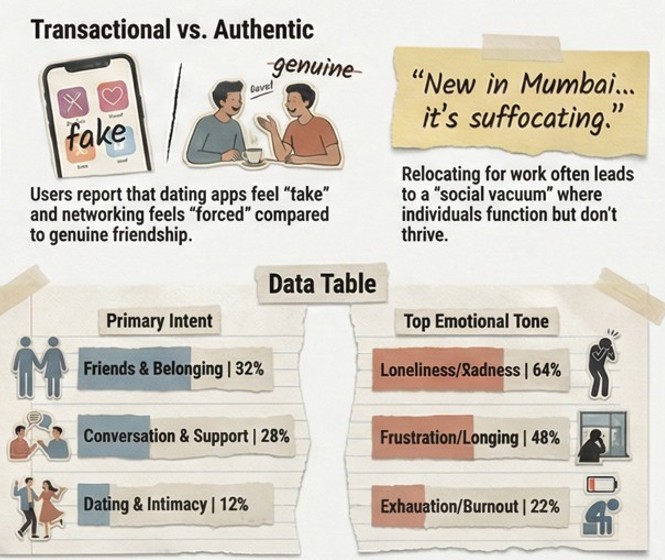
Read those again. Not excitement. Not ambition. Not even the standard urban ennui. The dominant emotional register of Mumbai’s young, connected, ostensibly thriving digital population is sadness and overwhelm. The city is running a hidden P&L of grief that nobody is accounting for.
A 29-year-old male from r/Mumbai writes: ‘Life has become quietly lonely, and I’m slowly getting used to it.’ That last clause is the one that should alarm us. Not that he’s lonely. That he’s habituating to it. Treating isolation as a new normal, a baseline condition, like the air quality. You stop noticing because you can’t do anything about it.
And at the far end of the spectrum, there are posts the data describes as ‘Red Flag’ territory. Acute crisis. Grief. Giving up. At least two posts in the 25-sample coded set contain explicit suicidal ideation, including a 26-year-old male from r/NaviMumbai and a 31-year-old female from r/Mumbai. These aren’t edge cases to be footnoted. They’re direct evidence that the loneliness epidemic in this city has a clinical tail that the mental health infrastructure of Mumbai is spectacularly unprepared for. The KIRAN helpline, iCALL, AASRA, they exist. But you have to know to look for them.
Social Thinning: The Post-College Cliff
The post-college friendship collapse is its own chapter in this story. The research frames it as a cliff. Ages 18 to 25, you’re embedded in institutional containers, college, hostel, the social scaffolding is automatic. Then work hits, the container dissolves, and what remains is a scattered network of people who are ‘catching up’ on WhatsApp rather than actually present. Forty percent of posts in the sample come from this 18 to 25 transitional cohort. Another 35 percent from the 26 to 35 work-life segment. Together, they constitute the entire arc of the post-adolescent social collapse in one city.
The verbatim that captures it best, from the original essay, bears repeating in full: ‘Most have either moved to different cities or are caught up in their own lives. I go back to my college friends only, but it’s exhausting and lonesome.’ There’s grief buried in that sentence. The slow erosion of once-effortless bonds. Friendship stops being a function of proximity and starts requiring scheduling, effort, negotiation. Most people give up before they realize they’ve given up.
The research calls this ‘chronic social thinning,’ a gradual attrition driven by marriage, migration, and work fatigue. Relationships transition from emotional bonds to transactional acquaintances. You move from people who know your history to people who know your job title. One type of connection is sustaining. The other is just networking with extra steps.
The Transactional Trap: Why Modern Tools Are Failing People
Here’s where it gets philosophically interesting. Or just depressing, depending on how much coffee you’ve had. The tools we built for human connection in the digital age, dating apps, networking events, interest-based meetups, are being experienced as actively alienating by the very people they’re supposed to serve. The Reddit data is quite specific about this. Users report that dating apps feel fake. Networking feels forced. Structured meetups feel awkward because you’re essentially being asked to perform charisma on command for strangers.
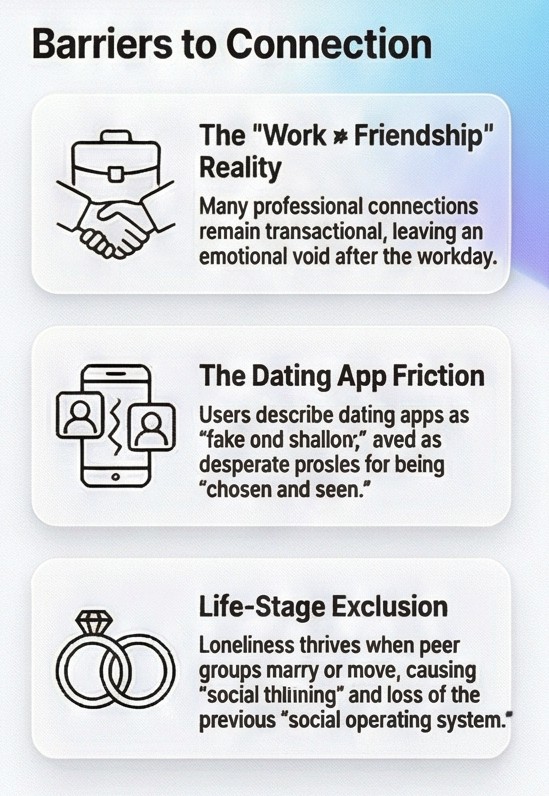
We were promised frictionless connection. Instead we got curated profiles, business-card conversations, and events where everyone is scanning the room for someone better while pretending to be present. The infrastructure exists. The chemistry doesn’t follow.
Fifty-five percent of users, more than half, say they want genuine friendship rather than professional or romantic transactions. Not Linkedin with feelings. Not Tinder with lower stakes. Actual friendship. The kind that doesn’t require an agenda. The kind you can show up to in a bad mood without ruining it. And only 15 percent are even looking at dating apps as a primary connection mechanism, which suggests that the app economy has completely misread the emotional demand it’s sitting on.
“Networking feels forced, dating apps feel transactional, meetups feel awkward. The tools exist. The chemistry doesn’t always follow.”
The research identifies what it calls the ‘Minimum Viable Human Circle’ as the actual object of desire for most posters. Not a grand social life. Not a curated group of interesting people. Someone to walk with. Someone to eat with. Someone to talk nonsense with. Someone to exist alongside without performance. That’s the bar. And somehow, in a city of 20 million, it’s proving nearly impossible to clear.
Searching for a Third Place in a Two-Place City
The structural diagnosis is worth sitting with. Mumbai is essentially a two-place city. Home and work. That’s it. The commute is so brutal, the hours so long, the rents so extractive that there’s neither time nor money nor energy left for the third place, the non-home, non-work space where organic community actually forms. Libraries, cafes, parks, hobby studios, the spaces that urban theorist Ray Oldenburg identified as the glue of neighborhood life. Mumbai has them, technically. It just doesn’t have the conditions that allow people to use them meaningfully.
The coping mechanisms the research identifies are instructive. Offline meetups, attempted by 45 percent. Sports and fitness by 30 percent. Hobby groups by 18 percent. Reddit communities themselves at 20 percent. People are trying. They’re not passive. They’re improvising, sometimes desperately, the social infrastructure the city has failed to provide. The insight in the data is sharp: ‘It’s not laziness. It’s a lack of infrastructure.’
What works, when anything works, is unstructured shared activity. Walks. Cafes. Sports. Low-stakes rituals where you’re doing something alongside someone rather than staring at each other across a table like you’re both auditioning for a role neither of you wrote. The intimacy follows the activity. It doesn’t precede it. That’s the design insight that most event organizers, app developers, and community builders in this city seem constitutionally unable to grasp.
The Silence Among Men
There’s a gendered undercurrent in all of this that deserves direct acknowledgment. The 82 percent male skew in connection-seeking posts isn’t just a demographic quirk. It’s a structural consequence of how emotional vocabulary gets distributed, or doesn’t, in Indian male socialization. The research is direct: men are statistically less likely to disclose loneliness face-to-face. Reddit provides the anonymity required to be vulnerable.
In male-coded posts, the request is consistently framed as a practical problem. ‘Where do I meet people without bars and clubs?’ But the emotional payload sits beneath. The fear of becoming habituated to quiet loneliness. The sense of being socially replaceable the moment peers move into marriage and family formation. The research frames it as ‘constrained vulnerability,’ which is perhaps the most accurate description of adult male emotional life in urban India that I’ve encountered.
Romantic failure, the data observes, carries extra weight for men in this context, acting as proof of social inadequacy rather than just a simple mismatch. Which means that the 12 percent seeking Dating and Intimacy are often not really seeking dates. They’re seeking evidence that they exist meaningfully to someone. That’s a much harder problem than Bumble is equipped to solve.
The 3 AM Post and What It Tells Us
Step back from the individual posts and look at what you have. Thousands of people, mostly young, mostly male, mostly in the 18 to 35 cohort that drives Mumbai’s economic engine, typing out their isolation into anonymous public forums because they have nowhere else to put it. The Reddit thread becomes a pressure valve. The post becomes the message in the bottle.
Independent research from Mumbai, cited in the analysis, confirms that living alone is strongly associated with loneliness, with very high odds for solitary household heads compared to those in joint family arrangements. The Times of India has framed it as a growing public health hazard. And yet the city’s response has been essentially nothing. Some mental health apps. Some awareness campaigns. The same Bollywood mythology of the city as the great equalizer, the place where ambition gets rewarded and belonging follows.
It doesn’t. Not automatically. Not for the 29-year-old who’s getting used to the quiet. Not for the 31-year-old who’s exhausted and stuck. Not for the 26-year-old who had thoughts of killing himself and typed it into r/NaviMumbai because that felt like the safest available option.
The epidemic isn’t hidden in some dark alley. It’s scrolling past us in plain sight, 64 percent Loneliness and Sadness, 48 percent Frustration and Longing, one r/Mumbai post at a time. In a city obsessed with velocity, people are slowing down long enough to admit they’re lonely. Publicly. To strangers. Because they have no one else to tell.
“The demand for connection is leaking out sideways.”
That’s the line that lands hardest. Not that Mumbai is lonely. Cities have always been lonely. But that the demand for connection has nowhere legitimate to go, so it leaks. Into Reddit threads. Into late-night confessionals to people you’ll never meet. Into the peculiar tenderness of strangers advising other strangers to try the gym, try a hobby group, try showing up somewhere alone even though it’s awkward, it helps.
Everybody’s improvising. Nobody’s cracking the code. And the city grinds on, dense and indifferent, handing out opportunity with one hand and taking community with the other.