
The Hidden Architecture of Depression in Champions
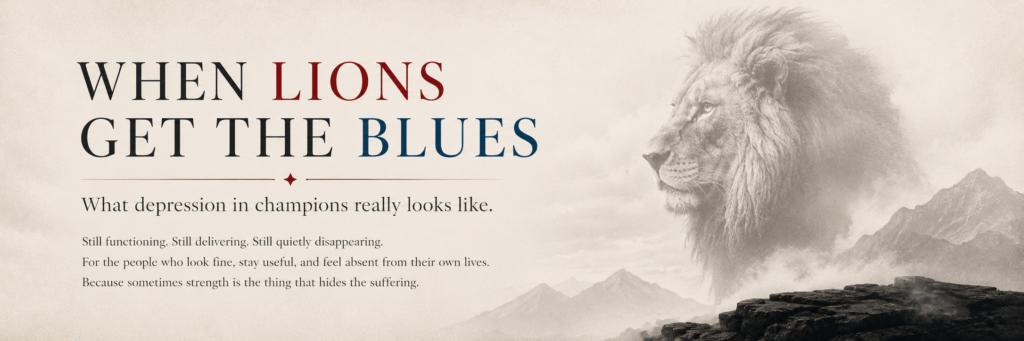
Nobody feels sorry for the lion.
That’s the whole problem. That’s the entire thesis in six words, sitting right there before we’ve even started. The lion is the apex. The top of the chain. The animal that nothing hunts. Feeling sorry for it is a category error, like weeping for the general or pitying the landlord. The lion eats. The lion leads. The lion’s roar carries eight kilometres across open savanna — not communication, a broadcast, an animal so settled in its territorial certainty that it announces its coordinates to every rival within earshot.
So when the lion gets the blues, we don’t have language for it. The story we’ve been telling doesn’t accommodate it. The story says that shouldn’t be possible.
It is, though.
Here’s what nobody tells you about the high-agency person and depression. It doesn’t arrive the way the literature says it should. There’s no dramatic collapse. No visible withdrawal. No psychomotor retardation, no inability to get out of bed, none of the external wreckage that the clinical world has trained us to recognise as the symptom. What happens instead is far more insidious and considerably harder to name.
The targets are still met. The boardrooms are still navigated. The output continues. And inside, quietly, in the dark, while the machine keeps running, the feedback loop that makes effort meaningful has broken. Completely. Silently. Without announcement.
This is what the researchers are finally calling High-Functioning Depression. Clinically it sits under Persistent Depressive Disorder. It’s defined, almost poetically, by its invisibility and its longitudinal weight. Two years minimum. Functional competence preserved on the outside. An internal world undergoing, in the clinical language, “chronic silent decay.” The phrase that keeps appearing in the literature is “smiling depression.” Which is a terrible phrase. Too gentle. Too cute. What it actually describes is a person running a burning building’s management systems from inside the building, while telling everyone the building is fine.
The high achiever views functional impairment as the terminal metric of illness. As long as the KPIs are green, they’re not sick. This is the competence trap, and it is exquisite in its cruelty.
The mechanism has a name too. The reward gap.
Neurologically, wanting and liking are different systems. Different circuits, different chemicals, different architecture. Wanting is incentive salience, the dopaminergic hunger that drives pursuit. Liking is consummatory pleasure, the thing that arrives when you’ve caught what you were chasing. In most functional humans these systems more or less track each other. You want the thing. You get the thing. You like the thing. The feedback loop closes. Effort felt like it mattered.
In the high-agency performer under collapse, the wanting system keeps firing. Ferociously. They pursue the high-stakes goal with everything they have. And then the achievement arrives, and there is no emotional payment. Nothing. A devastating dopamine crash at the exact moment of victory. The meaning of the effort has been hollowed out and nobody told them, so they find out at the finish line.
Viktor Frankl had an equation for this. D = S minus M. Despair equals Suffering minus Meaning. For the high-agency person, suffering is survivable if it plugs into a narrative of purpose. But in the post-achievement depression phase, when the professional victory arrives and the internal void is not only unaltered but somehow more visible, M drops to zero. The equation collapses. D equals S. Professional victory becomes the exact moment the existential vacuum is most violently felt.
The lion, who hunted everything it was built to hunt, standing over the carcass. Empty.
There’s a specific personality architecture where this collapse runs hottest. The research keeps landing on the same profile. Dominant cognitive function: Extraverted Thinking. Organises environments. Enforces execution. Treats the world as a series of problems to be solved with sufficient application of will and logic. This is, functionally, the entire identity of the high-agency person. It’s not how they work. It’s how they exist.
The structural weakness is in what lives at the bottom of the stack. Introverted Feeling. The function that governs core values and self-worth. In the high-functioning performer, this is the least developed, least conscious, most suppressed part of the operating system. It lives in the basement. And when the dominant logic-execution system finally hits a problem it cannot organise or execute its way out of, the basement floods.
The clinical term for this is the “grip.” The decompensation of the inferior function. The normally decisive commander falls into hypersensitivity, bitterness, paranoid projection. The belief, creeping and irrational and entirely resistant to argument, that they are universally unappreciated. That everything they built means nothing. That the world has looked at the full account of what they’ve produced and found it insufficient.
And then, often, the body makes the decision the mind refused to make. The somatic block. “ERROR: activity locked.” The system shuts down from the inside because the ego won’t stop issuing commands to a machine that has run out of fuel.
The loneliness piece is where it gets genuinely dark.
2025 Gallup and Pew data. 74% of men rely solely on a romantic partner for emotional support. One person. The entire emotional architecture of an adult life balanced on a single relationship. When that relationship fails, the isolation isn’t just painful. It’s absolute. There is no network to fall back on, because the network was built on activity, on shared doing, not on emotional disclosure. The friendships were real when the context was running. Take away the context, the network evaporates.
This isn’t a character flaw. It’s a structural one. The high-agency person is usually excellent at building activity-based networks. They’re surrounded by people. And almost none of those people know what’s actually happening inside, because the performance of stability isn’t vanity. It’s load-bearing. Subordinates project their need for an all-knowing protector onto the leader. Any display of human vulnerability becomes a threat to the system’s confidence. So the leader performs the stability. And in performing it, cements the isolation. And the isolation deepens the collapse. And the collapse is invisible because the performance continues.
The loneliness of command. Not a metaphor. A documented structural phenomenon.
What the research found in online forums, when the masks come off, is a particular kind of suffering that doesn’t have much public language. The theme that keeps recurring: successful but empty. Achievement has removed the social permission to suffer. You got what you wanted. You built what you said you’d build. The feedback from the world is that you’re doing brilliantly. And you can’t say that you’re dying inside because you’re a lion and lions don’t say that, lions just keep running the pride.
The coping strategy that almost everyone tries first is what the researchers call “Execute Backwards.” Apply logic and discipline to the internal collapse the same way you’d apply it to a business problem. Build a framework. Make a checklist. Optimise your way out. This is, as the research confirms and as anyone who has tried it knows, completely useless. The thing they’re fighting doesn’t respond to command architecture. It doesn’t have a KPI. It can’t be organised into submission.
What actually works is the opposite of everything the high-agency person’s nature demands. Stop calling it strategic burnout. That’s prestige language, a way of making the thing sound like a feature of high performance rather than an interior collapse. The clinical name is anhedonic despair. Call it that. Stop treating your internal life as an optimisation project. Pause the command. Not forever. Just long enough to find out what’s actually there.
The lion metaphor isn’t really about lions, which I think you already knew.
It’s about the specific uncanniness of watching the apex thing fail from the inside. The caged lion is a tragedy but it’s an explicable one. We put it there. We broke it. The math is obvious and the guilt is ours. The wild lion, though, in full territory, with everything it was built for, getting the blues anyway. That’s the thing that doesn’t fit. That’s the category error, the impossible case, the story we don’t have language for.
High achievers view functional impairment as the terminal metric of illness. So the first thing to understand is that the illness is not impairment. It’s the opposite. It’s the machine running perfectly on the last remaining thread of identity with traction, while everything else goes offline in the dark. The output is the symptom. The continued performance is the collapse expressing itself.
Final output is not proof of aliveness. That’s the sentence the research keeps arriving at, from multiple directions, through multiple frameworks. And it is the sentence that the high-agency person is most structurally unwilling to accept, because the entire architecture of their identity is built on the premise that it is.
Nobody feels sorry for the lion. That’s still the problem. That’s still the thesis, six words, unresolved. The lion doesn’t ask to be felt sorry for. The lion just keeps moving, keeps leading, keeps running the pride. Until the body makes the decision the mind refused to make. Until the basement floods. Until the roar that carries eight kilometres across open savanna goes quiet, and everyone standing near thinks it must just be resting.
It isn’t resting.